


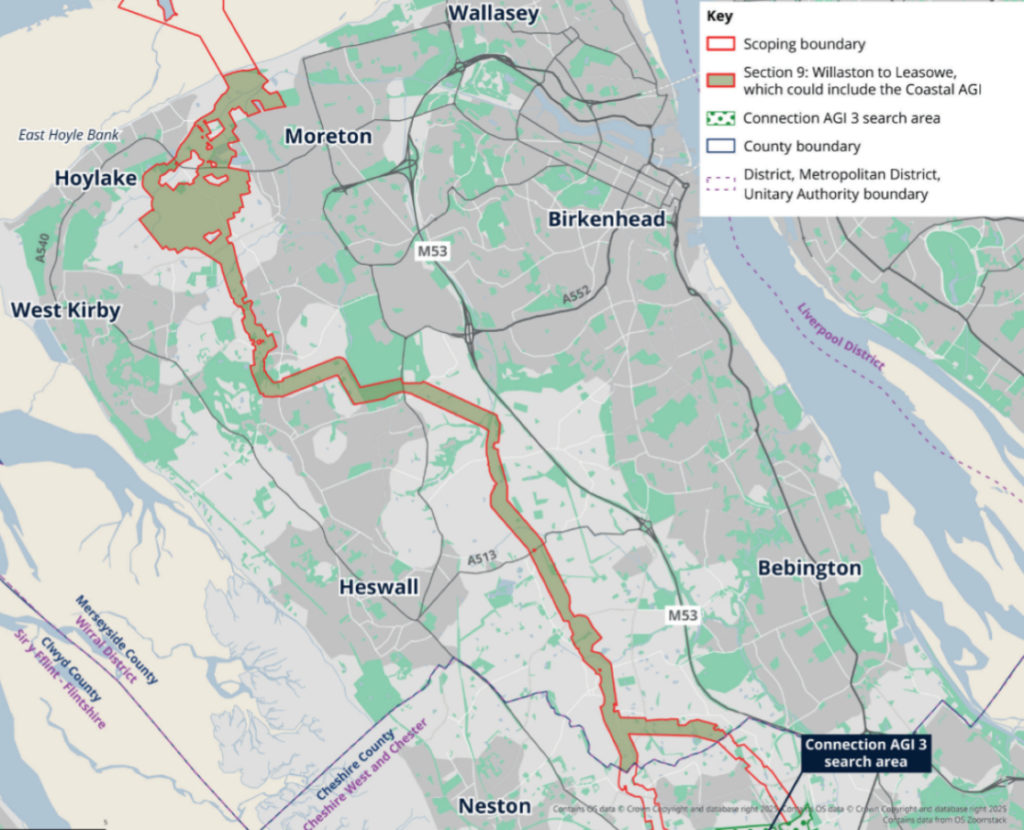
Campaigners are mobilising over plans for a carbon capture scheme which could see an underground pipe built through Wirral and a maintenance works constructed near Meols.
The proposal, which is designed to help the cement and lime industries reduce greenhouse gas emissions, would see producers in Derbyshire and Staffordshire each developing facilities at their sites.
They would be linked to a pipeline to transport the emissions through Cheshire and Wirral (the route is pictured above), then offshore to permanent storage in depleted gas reservoirs under the East Irish seabed near Morecombe.
Hundreds of people turned out for a public consultation event in Hoylake last weekend, with one West Kirby Today reader who attended telling us that the organisation behind the proposal, Peak Cluster, appeared unprepared for the numbers who poured into the building when the doors opened.
Local Conservative councillors Andrew Gardner and Max Booth are opposing the scheme, having already concluded that “the technology simply isn’t robust enough” and that the case for routing it through Wirral “has gone unanswered to our satisfaction”.
Wirral West MP Matthew Patrick has asked for a meeting with the company “to find out more details about the proposals and to discuss some of the concerns that have been raised with me”. He said his priority is that there is “meaningful consultation with our community, especially in regard to the precious nature we have here”.
The Chief Executive of Peak Cluster, John Egan, has told the Local Democracy Reporting Service (LDRS) that the route through Wirral is “the most feasible”, and similar to the existing natural gas network which runs underground, albeit containing carbon dioxide.
A protest group – No CO₂ Pipeline – has organised a public meeting on Sunday 1 February at 2pm at St Hildeburgh’s Parish Church in Hoylake, which they describe as “an opportunity for residents, landowners and professionals to come together, share information, and begin making sense of the consultation process and its impacts on wildlife, land, coastlines and local communities, including human impact”.
Under planning laws, the final decision will be taken by the government rather than the council due to it being what is known as a ‘Nationally Significant Infrastructure Project’.